We learn so much about life based on what was modeled to us from a very tender age. Some of us, even in our adult lives will still be provoked or triggered by certain events from the past because we are probably still struggling with navigating unstable emotions; what we think and believe about ourselves, about love; disappointments, loss, grief or whenever those big resonating feelings start to build up.

Meet Amira, my very witty Gen-Z 16 year-old-client with social emotional disturbances. She loves Drake the rapper and singer from Canada. I barely know him, but I do know about Drake from state farm, I’d told her once and received a very dry sober look but with a hidden smile.
I loved that. It means she acknowledges my outrageous sense of humor and presence.
But to better understand and utilize an appropriate clinical treatment for her, and a sustainable person-centered-planning, I had to go learn more about her obsession with Drake’s song; titled ‘Yebba’s Heartbreak. While it took me days to dilate the triggering mention of ‘I do’ from the song, I was able to be empathetic by encouraging open-ended conversation, position myself subconsciously within the lyrics now parading my brain, feel her hurt from the trauma surrounding the message in Drake’s song and to better grasp the reason behind ‘Yebba’s outspoken advocacy for mental health awareness and support.
Emotionally, after 2 weeks of playing the lyrics over in my head, I got younger at heart, gained a new young friend as we became closer with a dash of confidence.
And then the talk started…

Today, if you are reading this, I am asking…
How many of us have tucked in some very critical issues that’s still bitting deep down and affecting our healing process? Were we ever cautioned as children to keep-that-hurtful issue to yourself! arm ourselves with boundaries! or never encouraged to practice the three emotional escape steps (“I Notice, I Feel, I Can”). Or probably, we were reprimanded for even nurturing tender feelings of affection at a very young age? or instructed that embracing how you feel, talking about it and opening up means you are weak and vulnerable? Hmmm.
We cannot keep thinking of vulnerability as a weak and defenseless expression, while assuming that surrendering or submission of how we feel is like waving a white flag for peace in battle. Then whenever these big feelings start to creep-up our nerves, are we still believing that emotional vulnerability can sometimes be the only way we can discharge ourselves from boundaries that come from our default patterns of thinking that we develop from childhood?
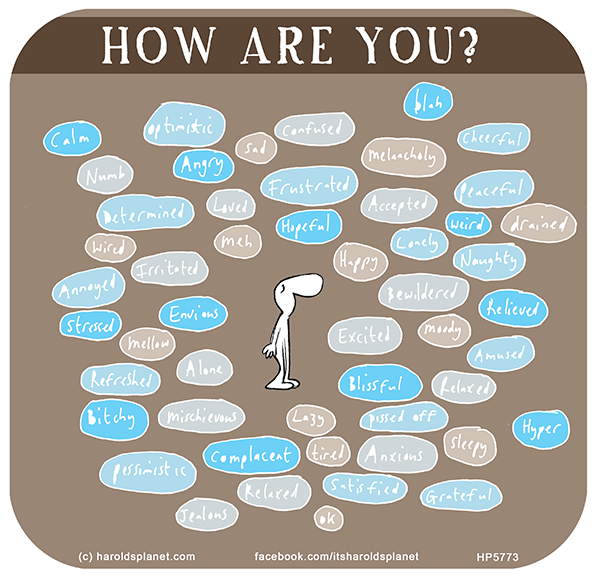
In a sudden moment, betrayal can make you go from feeling safe, loved, and known, to feeling vulnerable, unwanted, and alone. And we are told certain burdens are meant to be shushed?
But what creates those early default thought process anyway?
Well, to put it simply, our past experiences. The events that we’ve lived through, the responses and behaviors we’ve seen modeled, and repeated exposure to circumstances all play a primary role in how we think in the present. For most of us, the biggest factor in our default thought process is our family of origin; the way we grew up, the family we grew up in, and the way they interacted with us.

Help is here!
According to; Dr. Tiwalola Osunfisan, a Double-Board Practicing American Licensed Psychiatrist, Dr. Yemi Akinyemi; Professor of Psychiatry at Wayne State University & Dr. Kene Monplaisir of Acuitii. Dr. Nike Shoyinka, Miss USA Ambassador Angelena Taylor and Mental health advocate, Tinuke Odunlami, who all featured in my recently completed ‘Hey Sis, How Are You Developing Mentally Event in Michigan on 12/29/2023, leaving behind very important key points addressing Women’s mental health and giving suggestions on how to embrace speaking up and receiving treatment:
-Adversity is common to humanity. Do not compare, rather, focus on your process and growth.
– Be authentic! You can only maintain the best version of you and not someone else’s.
– Objectively evaluate all shades of you for optimal holistic wellness
– Choose improvement and progress over perfection. No one is perfect!
– Be God-centered and keep your purpose in mind. Let God guide you in all decisions.
– Have an attitude of gratitude. Gratitude for what you have, improves your mood and reduces anxiety.
– You cannot give what you do not have. So, intentionally fill your cup by taking good care of yourself.
– Self-care is not selfish rather, self-care involves any healthy activity that is intended to provide nurture to you in order to be more productive with your purpose and service to those around you.
– You are strong when you recognize when and how to seek help.
– Find your trusted tribe, mentor, coach and professional support. You are not meant to do this life alone.
– Speak up! Seek up! Support another! Spread the awareness!
By Dr. Tiwalola Osunfisan (Practicing American Double Board Licensed Psychiatrist):
Let Us Be Made New
So, our boldness in being expressive and seeking HELP doesn’t need to be grand and broadcast for all to see; it may not be as loud or even annoying as you might have thought; it’s certainly not measured by a lack of fear, but in actions in spite of that fear; and most of all, boldness is simply the act of bringing whatever you have to God and trusting Him with the outcome.
Can we begin to spend some time today recognizing our default ways of thinking and replacing them with truth? And then, remember, this isn’t a once-and-done process. It took years to develop our current mental playlist of thoughts, so let’s expect that it will also take some time and energy to create a new mental playlist.
But little by little, one thought at a time, this our new way of thinking (speaking up) will soon become the norm. Eventually, we will learn to be more expressive and fearless; never backing down from doing what is right; Be more vulnerable by allowing ourselves to get close enough to our truth; Be more compassionate by entering into our pain and owning our thoughts before they own us.
Yours in HOPE,
Yinka.
Michigan Endorsed Infant-Maternal Mental Health Specialist/Child and Family Licensed Psychologist.
 Moving Forward With Yinka
This is so profound and surreal! You are more than a story teller – I have read this like 4 times and wondering … where the heck have you been!!!!
Every girl needs to read this 👍 more, love this piece ❤️
LikeLike
This Drakes songs was also my teenagers favorite playlist and we got stuck on it for days until I took time to learn the lyrics of the songs.
Yes, it’s important to be expressive and feel what others are thinking about too. Thank you for sharing your thoughts Antonia👏
LikeLike
Every young adult- especially young ladies just discovering life is Amira. I see myself in her, I see my young daughters in her and wishes everyone would see them more and help with their needs. Especially trauma survivors
This is a beautiful piece of work Yinka👏👏👏💌
LikeLike
love this❤️
LikeLike