Understanding a child’s temperament: Autism Awareness

Photo by Ketut Subiyanto on Pexels.com

It is April, World Autism Awareness Month.

Let me begin by applauding all the great parents out there still committed and dedicated to helping with easing the acceptance of a given diagnosis, while following through with the prescribed-treatment plan for every child living with autism. I celebrate you! You did well! You are doing great!

Today, please take a 5-minute break, to look back at where you all started from, put on a happy expression, beam with gratitude or a smirk of “Just WOW” that displays your boldness, inspiring enough to tell stories of initial personal struggles, but later turned into a million little miracles of developmental victories, as you continue to surge forward in hope, for the future of your children. Remember, you are never alone.

Here I am speaking to you as a mother who has also experienced a child’s diagnosis+treatment on the home front, while my super hero cape is on and active as a licensed clinician of 20 years on the field, trust me when I say… ‘I DO understand what it is to journey through that road called… “Perhaps”
Photo by Polina Kovaleva on Pexels.com

Every child is born with his or her own individual way of approaching the world. I personally believe ‘Temperament’ stands out most as one of the unique qualities. Some will argue that, providing healthy and consistent validation on the part of the parents can help to instill a sense of worth and value in their child’s temperament as being seen and heard. While others believe that it is only critical to elevate the child’s emotional development through positive socialization, and development of a self-identity.

Hmm. To validate those emotions or not-to validate?

It is either a child’s temperament is easy-going, slow-to-warm, and active based on their environment.

Because childhood invalidation is thought to be related to many mental health issues in adulthood including an increased risk for both borderline personality disorder and narcissistic personality disorder. While invalidation may or may not include overt verbal abuse, its effects are typically longstanding and often carried with that child into their adult relationships.

Photo by Keira Burton on Pexels.com

There is No Right or Wrong Temperament.

It’s very important for children to be accepted for who they are. It is true, though, that some temperaments are easier to handle than others. A parent with an intense, reactive child or a child who is very shy and slow-to-warm-up will tell you that parenting these kids can be a challenge at times.  But, how can we learn when to tune in or acknowledge the child’s mood, while anticipating how they will react in certain situations without a display of their unique characteristic attitude or mood? hear this…

Temperament is not something your child chooses, neither is it something that you created. A child’s temperament shapes the way he/she experiences the world. A child who is cautious and needs time to feel comfortable in new situations and a child who jumps right in are likely to have very different experiences going to a crowded classmate’s birthday party. While the child who can handle a lot of sensory stimulation will experience a trip to the grocery store differently from a child who has a low threshold for a lot of surrounding noise and action. Same attitude, different reaction. 

And how do we respond (rather than react) to unexpected display of affection or outburst? aka: social tantrums or reported showdown by non-family members? Do we validate affectionately or otherwise?  hear this…

Maybe it is time we consider some characteristics that can describe a child’s temperament:

  • Emotional intensity – unstable moods, impulsive behavior and relationships
  • Activity level – the rate a child uses movement and physical skills to learn and explore
  • Frustration tolerance – dealing with setbacks (frustration or everyday inconveniences)
  • Reaction to new people – is this mutism or social phobia?
  • Reaction to change – some degree of discomfort without transitional plan

Child validation is the act of understanding and recognizing a child’s needs, feelings, thoughts, emotions, and non-verbal behavior as valid. It’s based on being able to empathize with a child’s trigger point and relate to their sensory-based reality or traumatic lived experiences.

On the other hand, invalidation is ignoring the child’s non-verbal attributes or when a child is made to believe that their needs, feelings, or lived emotional experiences does not matter. In other words, if conditioned in their childhood to believe that how they perceive their world is unreasonable or insignificant, these same messages can later generalize to feelings of insecurity, deep depression, issues in trusting themselves or others, and an unstable sense of self-identity.

Aha! here is my remedy: Be Your Child’s Champion! learn to follow their lead.

Have you ever found yourself feeling isolated from or being misunderstood, possibly even put down either by family, friends, and neighbors who disapprove of or judge your child? It can be empowering to see these situations as opportunities to educate others about your child. Step up!

For example, Abel is your son on the spectrum: you can explain to his aunt who is not getting the warm reaction expected from your child, “Abel, like a lot of other kids, needs time to adjust to new people or new environment.” You then hand her Abel’s preferred toy or favorite book, helping her learn to approach Abel slowly or change her diction to sensitively say …“It’s okay, I will just sit down next to you and wait while you are ready” “I see how you worked so hard building those blocks, maybe we can re-build together while you show/teach me” “Here, take my hands or show me how to help you”

Photo by Oleksandr Pidvalnyi on Pexels.com

So, understanding your child’s temperament helps you be a better parent. Recognizing patterns in your child’s behavior that are easily triggered by temperament can help you anticipate your child’s responses to certain situations. If you know that your child has a hard time making transitions, you can learn to work on visual schedule planning or gentle prompt-reminder system to ease the process of change. 

Sharing and observing your child’s strengths helps others see your child’s behavior from a different perspective, especially when derogatory names like ‘feisty nature’ are thrown carelessly around your child, take a deep breath, smile and allow the motherly instinct inside of you swell with pride and say “Hmm, Bella knows who she is and what she wants. She is loving and she is fierce. She puts her whole heart into everything.” Done.

Ordinarilly you might not be able to always control your child’s temperament, but you sure can navigate the triggers others bring around your child. Remember, the goal is not to change your child, but to help with adapting coping strategies and encouraging positive strength building.

While the month of April is dedicated to autism awareness, for me, everyday I am passionately connected to providing coping strategies+treatment for kids, providing individual personalized parent training, advocating for the importance of early detection in infant/toddlers and sharing resources with families in taking positive action… 

Conclusively, I implore all parents and caretakers to make the necessary sacrifices in understanding that autism is not solely a psychological/psychiatric disorder… … relatively it is physiological (neurological and biochemical) – meaning that there are things you can do to improve your child’s health, learning, and behavior.

A little bit of everything works! some nutritional changes, Joint-family social emotional support, traditional therapies like Sensory play therapy, ABA, speech, occupational therapy, etc.  but more important, the priceless “Cheerleader Cape’ you wear with them, and for them as they… continue to thrive.

For more information or free resources on: Infant & Maternal Mental Health/Early Childhood Education & Intervention/Autism Spectrum Diagnosis and treatment planning/Social Emotional Disorder/Advocacy for IEP with school-age children and more, visit us on our non-profit website: http://www.developmentalcarenetwork.org

Yours in HOPE as I share Mr. C Dollarz – Autistic

Yinka.

IMH-E, Licensed Infant/Maternal Mental Health Psychologist.

‘To Love Un-conditionally’ Our Autism Journey

Oby

As a proud loving Mother of two young awesome boys on the Autism Spectrum, my dear friend Yinka approached me to share little nuggets I learned on my journey. 

I. Was. Elated.

So, I decided to share my personal story following the diagnosis stages I went through with my sons. Which I know a lot of other parents  are familiar with as well, on this autism journey.

Stages – From a Parent’s Perspective

Shock 

“Your child has Autism Spectrum Disorder.” Says the Doctor. 

This has come as a shock to you even though you saw the signs, and you knew your child or baby was not quite developing like other kids his age. You literally feel like your world has come to a stand-still, even though it has not. 

Anyhow you want to put it, the words “Autism Spectrum Disorder (ASD)” sounds weightier than the actual situation. 

You scramble everywhere and anywhere for a cure. You join numerous blogs that make the situation dire than it is.

  • Denial 

Family and friends tell you your child is “Ok” and “Does not have Autism Spectrum Disorder. He/she is just slow

  • “You know boys are slower” They say… 
  • My cousin was slow, but now He’s great!” They say...
  • You want to believe them. You believe them...

After a couple of weeks, you realize the Developmental Doctor was right!

Your-Child-Misses-Major-Milestones.

  • Acceptance. Get to Work! 

After observing your child for some days/weeks and much research, you accept it.

In this stage:

Breath.

Take a cup of Coffee.

Shut your eyes for a minute.

Then get to work.

  • Research, Research, Research!
  • You will find excellent and great advice everywhere. 
  • You will also find depressive tales and more tales of doom everywhere. 
  • You will also find people who want to take advantage of you (financially), promising a total cure everywhere.

You will need to diligently research to find the right therapist (Board Certified Behavioral Analyst BCBA, Speech Pathologist, Occupational Therapist, and so on).

Get this information from your doctor, and very good blogs.

Please interview them to make sure they’ll be great fits not just for your child, but also for you and your family.

  • Avoid online scammers at all cost who promise solutions and prey on your desperation.
  • Avoid pity-parties at all cost. 
  • Avoid online groups, that make your situation seem so dire and even make you more depressed, at all cost.
  • Mental Health: 

As the caregiver, your mental health is vital.

Take care of it. 

You must be happy in order to impart happiness onto your child. 

This is important! I cannot stress this enough. 

If uncle Johnny makes you feel uncomfortable or unhappy whenever you bring your dear child to visit him, then stay away from Uncle Johnny.

If therapist Jane worsens your situation or does not really care for you or your child, then change therapist.

Have little tolerance for anything that’ll send you off to depression. 

There is hope always! Always!

Escape (even if it’s just for a few minutes) when kids are not with you, or when you have help. Carve out time for yourself.

Look for what makes you happy and take out some time DAILY. For me, I am a hopeless romantic.

I binge on all things romantic from the trilogy book “50 Shades of Grey” to Netflix’s “Love is Blind”. It makes me happy!

  • Support! Support!! Support!!! 

It takes a village! You need the support of family, friends, place of worship, care-givers. 

#YOU-CANNOT-DO-THIS-ALONE!

  • Let your Child Lead You! 

When you see a different behavior, ‘Your-child-is-NOT-WEIRD!

He/she is just different and learns everything about life differently.

Let your child guide you. Follow your child’s lead and discover how he/she learns. When you do this, you’ll see many windows of opportunity to teach your child and bring your child more to your world! It works! 

  • Positive Affirmations:

Because I am a woman of Faith, I believe in speaking words of Biblical Faith daily to my son. Speak words of Affirmation daily to your child. Teach your child to say these words daily.

When my son was much younger, I taught him a simple night prayer and to say the words “I am healed.” Now he says these daily words of affirmation before he starts his day: “I will be taught by the Lord, and great will be my peace and undisturbed composure.” (From Isaiah 54:13).

  • Excel/Flourish:

Once all these are in place, your child will begin to excel!

You will begin to excel.

Your family will begin to excel.

You are happy!

You laugh!

You play!

You rejoice!

Remember to jot down achievements, no matter how small (or big).

I call them “Praise Reports.”

Always remember that God is good, and that NO-ONE is a biological accident.

Your child is a blessing full and LOVE.

Your life and you child’s life have Purpose!

Absolutely! There is meaning to all this! In time you’ll find out. 

I love my BOYS. My life would absolutely be hopeless without them.

They-teach-me-daily.

Our dear Sons are amazing!

They show us the way daily❤️

We Love them dearly! 

I’d like to thank my amazing husband for his awesome endearing Love and full support. He is amazing!❤️

I also like to thank our awesome families for their amazing Love and full support.❤️

Much Love, Oby.

ABOUT HER: Oby holds a Masters in Electrical & Computer Engineering, Bachelors in Electronics Engineering. She worked for many years in the medical device industry with Fortune 500 companies in research & development, as well as leadership roles. She lives in Atlanta, GA and is happily married to Dr. Ekekwe for 16 years. She currently home schools her older son while the younger son attends school.

Yinka & Oby!

“Oby and I have been friends for over 30 years! #FGGC Sagamu Alumnus! A couple of years ago, we started talking more about her son’s autism diagnosis, Oby was very transparent and willing to share her struggles and triumphs, especially after knowing that was my field of specialization and passion. Overtime, she became an active member of my non-profit organization DCN “My Child Thrives” support group. Oby has been a vibrant, assertive and valuable resource to other members on the forum. She is certainly a force to reckon-with! Her witty takes on situations! her abundance of terms of endearment! as she showers group members with hope! ‘Autism diagnosis report certainly has nothing on this sassy lady!

Yours in HOPE!

Yinka!

as I share ‘Not Lucky, I’m Loved’ by Jonathan McReynolds to celebrate – April, ‘National Autism Awareness Month!

Emerging from The Threshing Floor

I once travelled with a childhood friend and her family to their village for Christmas decades ago. Our destination was to the eminent village of Oraukwu in Anambra State. Approximately 20km southwest of Awka, local govt center, and about 500km (7 hour-drive) to my home in Lagos.

Adventure Mindset,  checked! Mystified Expectations, checked!

River Niger Bridge, Onitsha, Anambra State.

As a teenager then, leaving my usual Lagos city life at Christmas and pledging to spend it outside my home for the first time came as a huge surprise to everyone, but I wanted more, so much more than the usual-fancy block-street carnival party that’s always been religiously celebrated by my Lagos-Brazilian Quarter families every Christmas.

So, here I was, surrounded with very little understanding of the Igbo language spoken around me. But I was most certainly comfortable with the usual ‘Ndo’‘Kedu’ ‘Odinma’ etc. greetings from well-wishers, even as my girlfriends and host were my interpreter! Lol.

Of all the pleasant people I met, the magnificent houses built like National Theater or something magical from a classical movie tucked away behind clouds of trees and dusty unpaved roads!

The fleet of exotic cars lined up as baseline to the entrance of gigantic gates, of all the flames from exposed make shift kitchens blaring up and convincing everyone of palatable feasts in production.

Of all the performances by the energetic village dancers or new exquisite soup like Oha to consume, I was more thrilled by the action of the group of women assigned to cook. 

Oha soup
Oha Soup

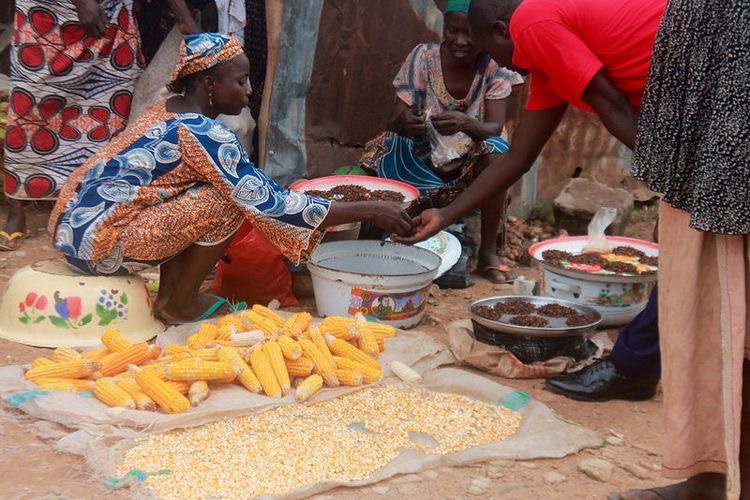
I stood astonished watching as their bodies swayed in unison, wiping away sweat from their foreheads while their laughter deepens, bare feet stamping over spread-out sack-like cloth on flat ground, digging their heels harder as if deliberately commanding the out-sprout of the contents inside the sacks.

With such naïve inquisition, I later learned it was a usual process of shelling the seeds of cucurbitaceous (squash, melon, gourd) plants which after being dried and grounded will be used as major ingredients by the women cooking. 

Wow! Such an intriguing resonating revelation!

That was the very first time I encountered the term ‘Threshing Floor’ in a cultural context: an evolution and transformation of seed/ grains. Well, until I attended the just completed heartening ‘Emergence Conference’ powered by Esther’s Preparation Room.

What-an-Awe-inspiring gathering of Purpose-driven Professional women on a Mission for God!!

What an exhilarating Thursday evening of deliverance from those fancy adornments we use as cover-up and fronts to please the world!, what a deliberate cry of mercy to disconnect from what/how the world requires women to look like, a purposeful drive to adopt 3-unknown prayer buddies! ‘beautifully delivered by Minister Raeni of Nehemiah Troop Prayer Ministry!

Oh, what a remarkable and powerful Friday of prayer/prophesies that exposed and released the hidden seeds during our threshing floor seasons, the rebirth of emergence within every womb of a woman by Sister Nike Fabemgbe of London Agape Prayer ministry!

And that awesome Gala evening …the KIB Foundation Launch and SHEroes Award night! ‘seeing teams of like minded people from all works of life, coming together to bring out the Abilities in all given diagnosis of Disabilities in children, especially in Africa!

Literally, could our lives be likened to those seeds, hanging on in (sacks) and refusing to undergo garnering? ‘What happens to us at the threshing floor? Self pity? Deliverance? Security allowance? Divine provision? the difficult discussions of life we dodge? And then, what happens after? When we allow the husk, the chaffs holding us back to loosen up and become renewed?

Can you relate to that? I do.

So, often during the times of our greatest challenges or need, we may find ourselves giving way to the stress and strain that comes with it by battling one another; forgetting who the real enemy is: 

Our Refusal. To undergo. The Basic Process of Threshing.

Visions are delayed, Harsh words spoken, friendships are broken; we choose sides and draw lines.

Feelings get hurt. Betrayal runs deep. Psychological sack cloths that are supposed to be spread out and trampled over like we are walking around the walls of Jericho to bring out the savviness in us, are still being hung up as emotional decorative mirror and admired like a lesser god in our hearts! 

It gets harder to forgive and keep moving forward. And sometimes we get stuck, right there in the broken mess of it all. 

We wobble on a spiritual tightrope, fearing the slightest misstep off the threshing floor will toss us back into the canyon of God’s disapproval.

Hmmm.

Today, as you are reading this, I pray we all come to understand the blessing and pass on the lessons learned from those challenges we encounter during the season we find ourselves on the threshing floor, to accept it as a mission for evolution, materialization and possibilities to be used by God. 

To see ourselves as those seeds or grains loosening up from the chaffs of impossibilities, out of the sacks of limitations and into a new season of our lives. Not necessarily as a punishment, but as re-birth!

*** A big salute to all Esther’s Preparation Room, Katherine Israel Bolarinwa Foundation (KIB) and Emergence Conference Planning team! 

As an organization, we are humbled by the mandate we have received from the Lord to raise a new generation of professional Christian women who will dominate and impact their sphere of influence for the Kingdom of God.

There is a cultural shift coming and EPR has been positioned to be on the cutting edge of this new movement. We are actively preparing to rollout our various global programs which will empower each woman to (i) raise her leadership lid, (ii) sharpen her skills, talents and gifts, and (iii) identify the niche audience/market she’s called to serve“.

Adenyke Israel-Bolarinwa 
Executive Director
Esther’s Preparation Room (EPR)
http://www.developmentalcarenetwork.org

Thank you EPR, Women who have experienced challenges, who are not afraid to cut through threshing sacks, willing to emerge, stem the tide of childhood mortality in Africa, Women created to improve the well-being of the African child, by giving them a chance to ultimately pursue a full life – beyond any dis-abilities, any diagnosis or any discouragement!

Thanking God for an awe-inspiring 2019, as I embrace and welcome everyone to year 2020, A new year of ‘Boldness in Moving Forward”

Yours in HOPE,

OlaYinka Gansallo-Lawrence

DCN Founder.

As I share…’Lauren Daigle’s Rescue from Grey’s Anatomy!

A light for her pathway – Autism Journey


Val 1

As the month of April comes to a close, many have spent the month bringing
awareness to the many faces of Autism. As any parent or family member who has
a child on the Autism Spectrum knows, this life is exactly that:

‘A Lifelong Experience’

I am blessed with two sons, both on the Autism Spectrum.

Now that they are grown, Ages 21 and 22, I can reflect on the many moments, early on before diagnosis, when I was full of doubt and confusion, thinking I was a terrible mom and simply did not know how to raise children.

What I didn’t realize was that I was being prepared for a life of adventure, smiles and small victories that would be major accomplishments in my eyes. No matter what, we are still parents. Parents of children that have so much potential and as their parents, we must remember that we are their best advocate.

We are also the ones to teach our children the life skills they need to survive in this unforgiving world.

As my sons have grown older, I have realized how much more they need assistance in everyday social situations. When children are younger, supports tend to be everywhere, but as they grow older, those supports seem to be less and less, especially if the child functions high enough to go to college or have a job.

Teach your child to be a good citizen that can function in society to the best of his/her ability. If your child is very young right now, this may seem a lifetime away however, before you know it, you will be looking at each other saying “Now What?

Keep in mind, while this may seem overwhelming at times, remember there are others who have been in your shoes and you CAN do this, and so can our kids!

Never be afraid to reach out to those in similar situations for support.

Together, with prayers, patience, community support and love, we can nurture young minds and raise resilient adults when we focus on their potentials now.

Written by: Valerie Lawson.


*For the past 3 years, Valerie and I usually meet one Friday in a month after clinicals at different Panera Bread locations to brain storm on assessment & treatment planning for children with disabilities, pray about challenging caseloads, talk- deep about life, laugh out loud & silly like teenagers over bowls of clam chowder as we continue to implement developmental disabilities initiatives. I met Valerie in class during  my practicum/residency program Fall of 2016).

Valerie is a Behavior Consultant with DCN Autism Clinic in Michigan, a caring and devoted mother to two young men with Autism, ages 21 and 22 years old.

Yours in HOPE!

Yinka.